
One of the most well-known revolutionary events of the War of Independence occurred in Knocklong, Co. Limerick, in May 1919. The rescue of Seán Hogan at the village’s railway station was pivotal in initiating revolutionary activity in Co. Limerick from mid-1919 onwards. However, it was to be over a year later that an IRA Flying Column came into operation in East Limerick, and notable action followed in the Knocklong area.
The main engagement took place on the 10th of December 1920 and was known as the Red Gate or Cross of the Tree ambush. The name ‘Red Gate ambush’ came from a large red wooden gated entrance to a country house located about halfway between Garryspillane and the Cross of the Tree. This was where the East Limerick Brigade Flying Column, under the command of Donnchadha O’Hannigan, set up their ambush.
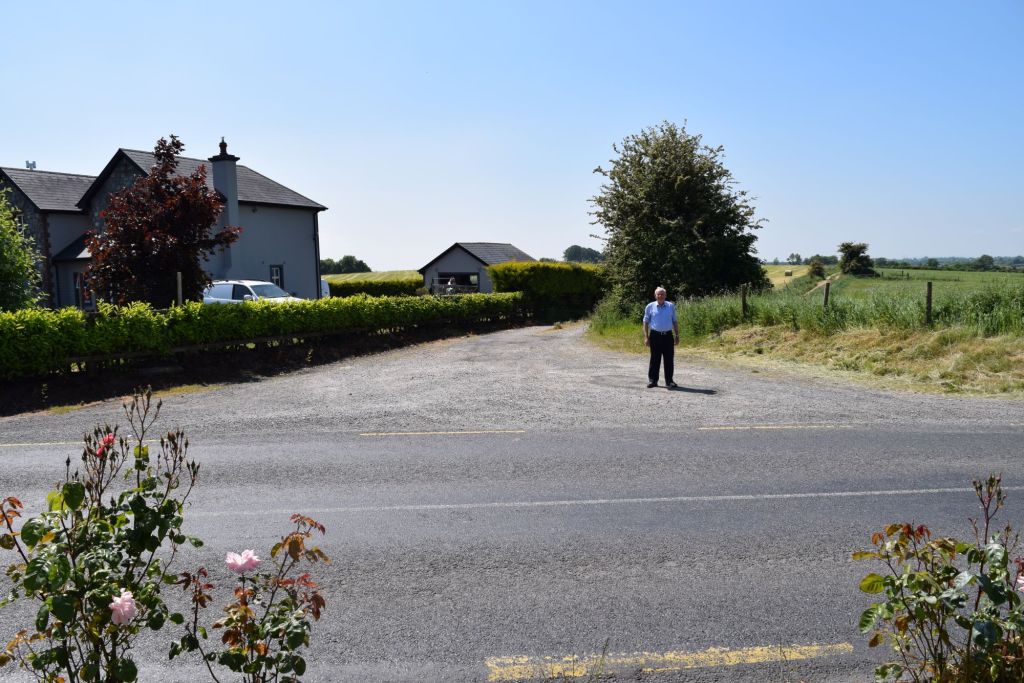
The Flying Column had spent the previous night in Con Kearney’s, a safe house that was also used as Martinstown Company HQ, then moved East towards the main Knocklong – Garryspillane road. Their specific target may have been an Intelligence Officer, Lt. Harold Brown, but the generally accepted information was that the Volunteers knew two lorries of ‘Tans’ were on the move from Galbally towards Knocklong.
Whatever the exact reason, the planning was hasty and reactionary, and only about a dozen members of the Flying Column were available. They were joined by some local Volunteers and formed an estimated 20-strong force armed with rifles, bombs and revolvers. They took up positions at the Red Gate, where a barricade was created using a cart of hay that was driven into the ambush position by a local shortly after 4 pm. The positioning placed most of the Flying Column behind the western stone walls that flanked the red gate (these Volunteers included D. Clancy, D. Noonan, D. Moloney, M. Costello, J. McCarthy, and D. O’Hannigan). It seems that a few men were also positioned on the opposite side of the road and a few more along the road 100m south of the ambush site.
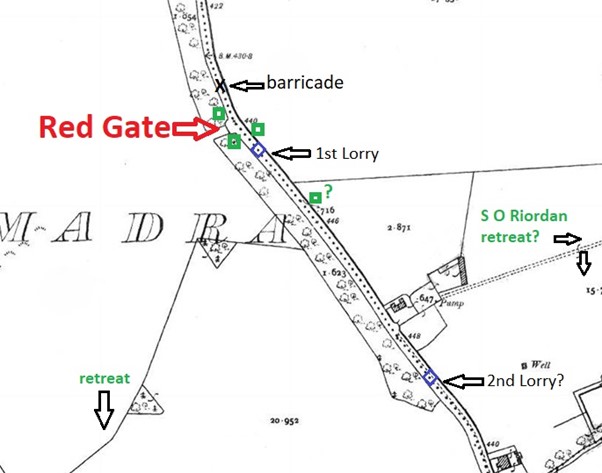
The first lorry drove into the ambush zone and stopped at the ‘red gate’ or just south of it, possibly because the driver had spotted the IRA’s barricade. The second lorry failed to advance into the ambush position and stopped about 300m south of the ‘red gate’ about 10 minutes later. In any event, IRA Volunteers Costello and McCarthy threw bombs at the lorry load of crown forces, but they failed to explode because their detonators had been removed! This wasn’t an act of sabotage but a lack of oversight. Earlier, Volunteer D. Tobin had asked a comrade to look after the bombs while he took dispatches to Mai Moloney at Lackelly. The man would only accept if the detonators were removed from the bombs; Tobin agreed and kept them with him, not realising the ambush would begin while he was gone. Incidentally, Tobin was drinking tea at Fr. Humphrey’s house, 560m north of the ambush site, with the detonators in his pocket when he heard the opening shots of the ambush, but it was too late to return them.
Much confusion surrounds the engagement, not least the name of where it occurred. In addition, the official IRA Brigade reported it as having happened in December 1920 or January 1921. Also, some put the failure of the ambush down to a premature shot having been fired (BMH.WS1412), while others point to the failure of the bombs to explode to initiate the attack (BMH.WS0992 and WS1451). It seems that Lt. Harold Brown was travelling in this first lorry (or in a car immediately behind). As he stepped out on the road, Volunteers Clancy and Noonan opened fire and were sure that they hit their target a number of times and could only later speculate that Brown had been wearing some form of armour under his uniform. After little more than 10 minutes, the Military were called on to surrender and seemingly did so; the Volunteers in rearguard positions to the south then moved onto the road towards the lorry.

At this stage, the soldiers from the second lorry that stopped further south moved northwards along the fences and opened fire on the Column. Donnchadha O’Hannigan, Column O/C, sounded the retreat, and a small number of riflemen put out covering fire as the British forces attempted to outflank them. One of those that remained, Seán Riordan (an ex-soldier and, therefore, one of the more experienced members of the Flying Column), was shot in the abdomen but maintained fire to cover the retreat. Badly injured, it seems that Riordan moved from the position in a different direction and was picked up by a local man, Tom Ryan, with a horse and trap and was taken to the Ryan household in Raheen townland. Here the Column found him being treated by Dr Fitzgerald and removed him to Hennessey’s safe house and on to the Union Hospital in Kilmallock. Here, in essentially the same building that housed a detachment of Blank and Tans, Riordan was operated on by Dr McNamara but died a few days later. Seán Riordan was later buried in secret at Darragh graveyard.
It seemed that the hurriedly planned action was a series of errors. The bombs had no detonators, and the ambush ‘position selected couldn’t be worse as, in the event of a surprise, there was no cover for retreat only over large extensive fields’ (BMH.WS1435). A preferable position might have been just 100m further north, but the distance between the travelling lorries would still have been a crucial factor. The result was that an experienced IRA Volunteer was killed, no munitions were captured, and no casualties were reported on the British side. However, months later, a court hearing showed that some Crown Forces were injured. Nevertheless, The Red Gate ambush was undoubtedly a failure from the IRA’s perspective.

The Red Gate itself is long gone, but the road is the same, although much improved, and nothing yet marks the events of that Friday afternoon more than a hundred years ago.
If you have any more interesting stories, memories or objects connected to the East Limerick Brigade, share them with us next Tuesday (27th of June) at the Knocklong Community Centre. Our revolutionary workshop will begin at 7 pm in the community centre, and all are welcome to attend.

Sources used in the creation of this blog include:
WS Ref #: 1435 , Witness: Daniel F O’Shaughnessy, Member IV and IRA, Limerick, 1918 – 1921
WS Ref #: 1451 , Witness: Edmund Tobin, Officer IRA, Limerick, 1921
WS Ref #: 1412 , Witness: Michael Hennessy, Member IV and IRA, Limerick, 1914 – 1921; Member Flying Column, 1921
 Landscapes of Revolution